
Google Just Made Agentic-AI Native to Email, Docs, and Ops. This Is Big.
A simple breakdown of how Workspace Studio changes daily ops for lean teams.

If you’re a founder, you probably feel the constant drag of operational work. Stuff like email triage, drafting docs, and coordinating handoffs. None of it moves the business forward, but all of it takes time.
Google’s new Workspace Studio aims right at this pain point. Unlike past attempts at automation, this one lives where you work. It’s built into Gmail, Drive, Docs, Chat, and the workflows that keep your company running.
It’s not a “lab experiment.” It will shift how teams handle day-to-day operations and help founders gain leverage without headcount.

What Google just shipped (in plain English)
Workspace Studio lets anyone build AI agents directly inside the Google tools your team already uses. There’s no coding, data connectors, or Zapier-style logic puzzles involved.
It’s simple. You describe what you want an agent to do. Gemini 3 builds the workflow. Then the agent runs natively inside Workspace.
Workspace understands your emails, attachments, docs, and shared files. It can route tasks, generate content, extract data, coordinate approvals, or handle multi-step processes that typically require someone from ops.
Google says users have already run over 20 million tasks through Workspace Studio in 30 days. And teams like Kärcher report 90% faster drafting times for complex workflows.
This isn’t hype. This is the beginning of Workspace becoming an operating system for agentic work.
How these Agents actually work
Workspace Studio sits atop Gemini 3, Google’s newest multimodal model. That matters because these agents can:
read and understand documents
reason across context
extract structured data
follow multi-step logic
adapt to new information
keep track of state within your workflows
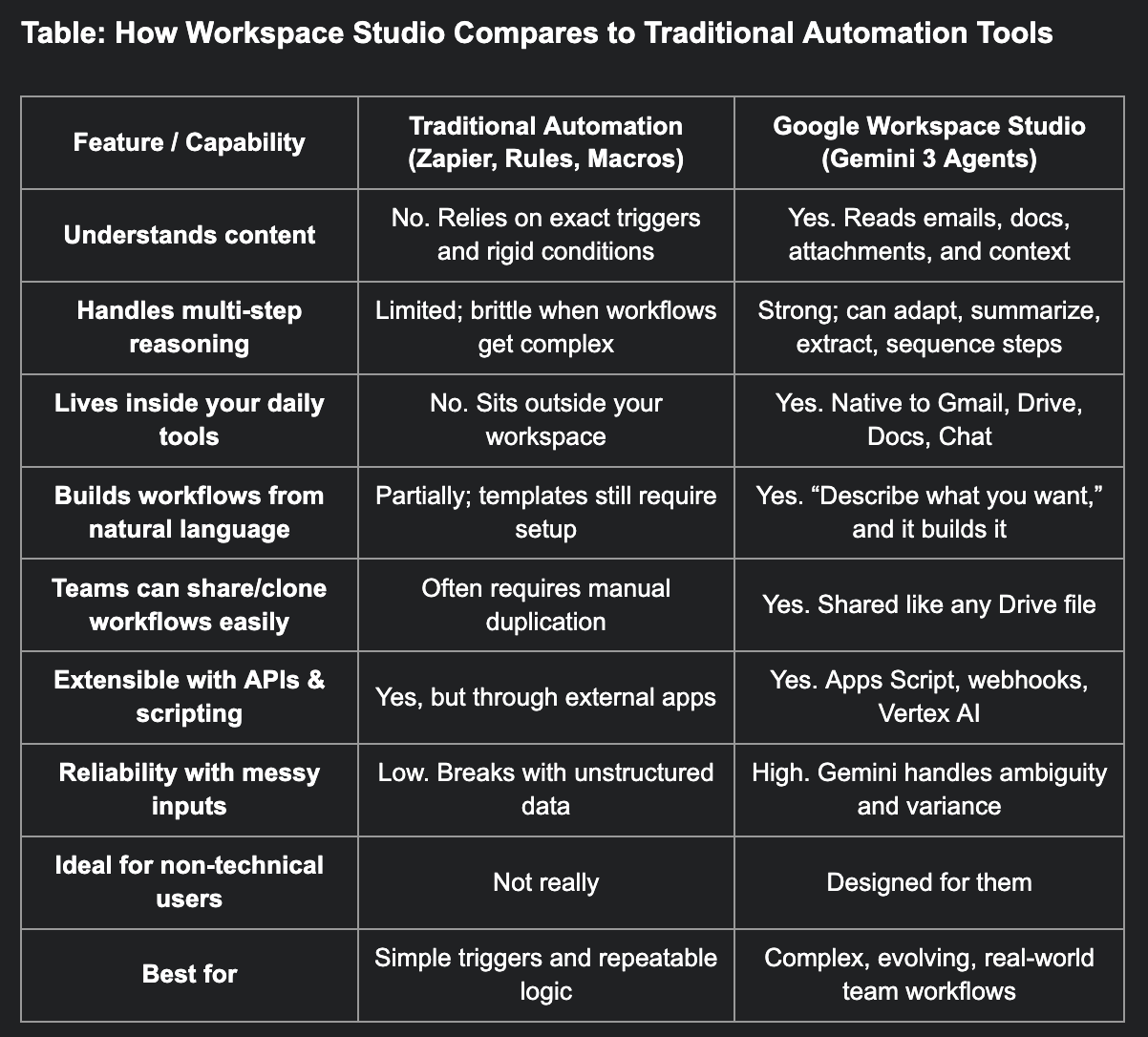
This is a big break from traditional automation. Old rule-based systems could handle triggers (“If email from X, label Y”). But they couldn’t think or interpret nuance. They certainly couldn’t make judgment calls.
But Gemini-powered agents can. That’s why Google emphasizes that these aren’t “macros.” They’re contextual workers.
A Good Example: Kärcher’s Virtual Team of Agents
Before Workspace Studio, Kärcher’s product teams evaluated new feature ideas with a messy workflow: meetings, scattered notes, manual synthesis, and long bottlenecks.
Now they use a chain of agents:
a brainstorming agent evaluates the idea
a technical agent checks feasibility
a UX agent outlines user flows
a user-story agent creates a polished user story
What used to take hours of coordination now finishes in two minutes. These agents go beyond simple automation to coordinate with one another. So, in a sense, teams aren’t really adopting a single agent. They’re adopting a small virtual team.
What founders can deploy right now
Founders can already deploy several high-impact agents inside Google’s new workspace right now. These are the wins that save time immediately without changing how the team works.
Inbox intelligence: An agent can pull real questions out of long emails, flag high-priority threads, extract deadlines, and surface anything that needs a reply. Founders live in email, so this one workflow pays for itself.
Daily Ops Routing: A simple chain: email comes in → the agent extracts details → creates a task → notifies the right channel in Chat. No human triage needed.
Document drafting: Status updates, investor notes, onboarding docs, and the weekly explanations founders repeat can be drafted from a few inputs. It cuts out a surprising amount of low-value rewriting.
Team coordination: Agents can handle approvals, ping stakeholders, or escalate issues across Slack, Teams, or Discord using webhooks. It keeps small decisions moving without a manager babysitting the workflow.
Lightweight product ops: Reasoning agents can be sorted and routed with feature requests, support tickets, and bug triage.
These are “now” use cases, not future promises. As teams stack them together, the compound effect becomes obvious fast.
Why agents are different from Zapier-style automation
Automation tools have existed for years, but they always hit the same limits. They are usually too rigid, too confusing for non-technical users, or too disconnected from the core apps people actually use.
Workspace Studio changes this dynamic because:
1. The agents live inside the actual work tools. Not beside them or on top of them. Inside them.
2. They understand content, not just triggers. They read your docs and interpret attachments. They even parse messy inputs.
3. They reason. They don’t just follow rules - they follow goals. This is exactly why founder productivity is about to jump.
How teams can extend these agents
Teams that want to go deeper have plenty of room to extend these agents. For instance, Apps Script can add custom logic, webhooks let you connect to outside systems, and third-party integrations cover tools like Jira, Salesforce, Asana, and Mailchimp. You can even swap in proprietary or fine-tuned models through Vertex AI.
Founders can start without engineering, and engineers can step in later to deepen the system. As the business matures, the agent network matures with it.
What this means for startup costs
Startup costs change significantly once agents take over the repetitive work that founders usually outsource. They won’t replace specialists, but they absolutely take over inbox cleanup, meeting follow-ups, internal doc drafting, triage, data extraction, and routing information.
For a small team, it’s the first time internal ops can feel like you’ve added a few extra hands without adding headcount. That frees more of the budget for growth, product, and revenue work instead of admin overhead.
What’s still missing (and worth tracking)
Workspace Studio may seem like magic, but founders need to monitor a few items:
agent reliability across long workflows
real-world edge cases
webhook stability
cross-system coordination in heavy workloads
limits around email sending and domain rules
Google is already hinting at upgrades for external sharing and webhook control, so expect this to improve quickly.
The founder’s takeaway
Workspace Studio’s launch signifies that agentic-AI is no longer an add-on. It’s becoming the default layer of daily work.
Anyone can gain access to Studio, and it puts them right where teams already spend their day. So there’s no setup friction or new habits to learn. For founders, their next few moves should be:
Start small.
Automate the annoying stuff.
Build a few agents that remove busywork.
Let your team focus on judgment, strategy, and creativity.
Workspace Studio appears to be the new foundation for lightweight ops. And the companies that embrace agentic workflows now will feel that advantage immediately.